By the time that the Declaration of Independence was adopted in July 1776, the Thirteen Colonies and Great Britain had been at war for more than a year.
During the first year of the war some colonists believed reconciliation with Britain was still possible, but events early in 1776 swung public opinion towards favoring independence. In February 1776, Parliament passed of a law which established a blockade of American ports and proclaimed American ships to be enemy vessels. Growing support for independence ensued when it was confirmed that King George would be sending German mercenaries to subdue his American subjects.
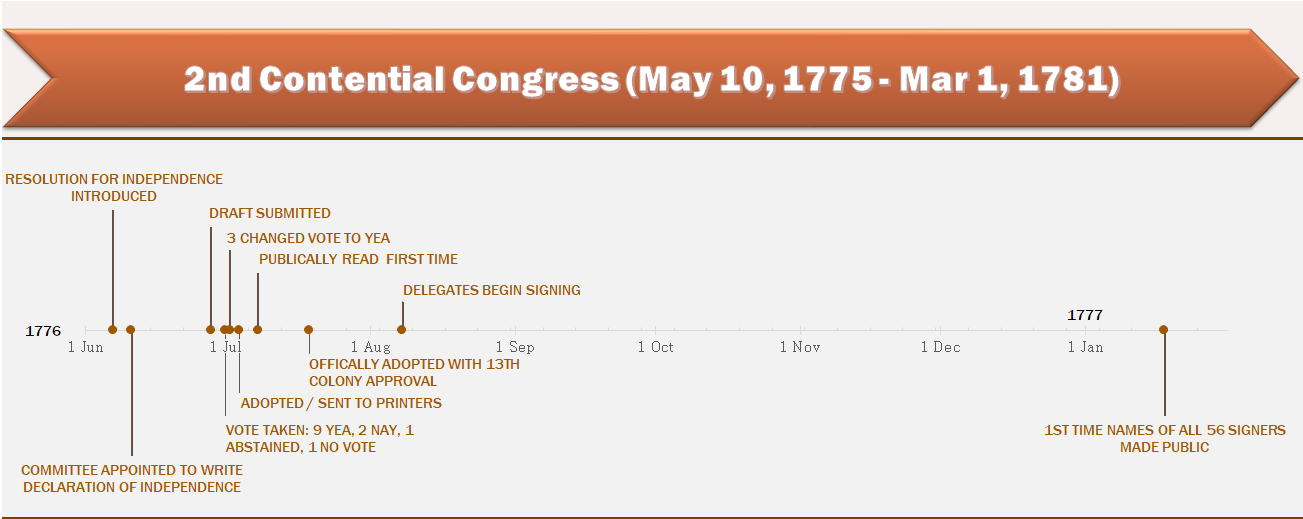
The first official act towards declaring our independence occurred on June 7th 1776.
- 7 June 1776. During the Second Continental Congress in Philadelphia, Richard Henry Lee from Virginia submitted a resolution calling for independence from Great Britain. At the time Lee declared, "Let this happy day give birth to an American Republic." However, since it was believed not enough delegates yet favored independence, voting on the resolution was delayed to allow time for growing support for independence.
- 11 June 1776. The Second Continental Congress appointed a committee of five delegates to write a declaration of independence. The committee consisted of John Adams, Benjamin Franklin, Roger Sherman, Robert Livingston, and Thomas Jefferson who was appointed as chairman of the committee.
- 28 June 1776. The draft of the Declaration of Independence was presented to the Continental Congress. Between this date and 4 July, 86 changes would be made to the draft. The actual title of the Declaration of Independence was "A Declaration by the Representatives of the United States of America, in General Congress assembled".
- 1 July 1776. After a long day of speeches, a committee vote was taken on the Declaration of Independence. Each colony cast a single vote. Pennsylvania and South Carolina voted against declaring independence. The New York delegation lacked permission to vote for independence and therefore abstained. Delaware did not vote because its delegation was split. The remaining nine delegations voted in favor of independence. The next step was for the resolution to be voted upon by the full Congress.
- 2 July 1776. The South Carolina, Pennsylvania, and Delaware delegations reversed their stance on independence and voted in favor of the Declaration of Independence. The New York delegation again abstained. The resolution for independence had been adopted with twelve yes votes and one abstention. With the passage of the declaration, the political ties between the colonies and Great Britain were officially dissolved. In a now famous letter written to his wife on the following day, John Adams predicted that July 2 would become a great American holiday believing that the vote for independence was what would be commemorated.
“I am apt to believe that [Independence Day] will be celebrated, by succeeding Generations, as the great anniversary Festival. It ought to be commemorated, as the Day of Deliverance by solemn Acts of Devotion to God Almighty. It ought to be solemnized with Pomp and Parade, with shows, Games, Sports, Guns, Bells, Bonfires and Illuminations from one End of this Continent to the other from this Time forward forever more.”
- 4 July 1776. The Continental Congress adopted the Declaration of Independence and sent it to the printers. It is believed by many historians that Congress President John Hancock was the only one to sign the document on this day.
- 8 July 1776. The Declaration of Independence was read publicly for the first time after the citizens of Philadelphia were summoned to the State House Yard by the bells of the city. The bells of the city rang long into the night in celebration. 19 July 1776. The Declaration of Independence was officially adopted when the colony of New York, the 13th colony, finally gave its approval.
- 8 August 1776. Delegates from each colony began to sign The Declaration of Independence. Eventually the document would contain the signatures from 56 delegates. The signature of John Hancock stands out for its large lettering. At the time the British had a reward of 500 pounds ($50,000) on the head of Hancock. After signing, Hancock stated the British monarch, George III, "could now read his name without glasses and could now double the fine." Stephen Hopkins from Rhode Island stated while signing with his palsied hand, "My hand trembles, but my heart does not." Benjamin Franklin declared, "Indeed we must all hang together, otherwise we shall most assuredly hang separately."
- 18 January 1777. Congress ordered broadsides of the Declaration of Independence, containing the names of all 56 signers, to be printed and sent to all thirteen colonies. This was the first time that all the names of the signers were made public.
The Declaration of Independence is the birth certificate of our country and was the first public document to use the name “The United States of America”.
It is the first successful declaration of independence in history and has helped inspire countless movements for independence, self-determination, and revolutions from 1776 to this day. As one European observer noted in 1849, “the Declaration of Independence was nothing less than the noblest, happiest page in man-kinds history”.
From: Sons of the American Revolution 250th Anniversary
Event Planning Guide Independence Day 2026 Working Group
Committee Members: Dale Corey, Tim Dioquino, Scott Giltner, Ed Hoak (Chair), Tom Jackson
National Society Sons of the American Revolution